
Cognitive Engineering: Designing a Decision System That Fails Less Often
Why your P&L depends less on your IQ and more on how you instrument your own thinking.

Most “thinking better” advice starts from the same hidden assumption:
Thinking is something that happens inside your head.
If that were true, then the way out of your cognitive limits would be obvious: upgrade the hardware. Meditate more. Read more. Grind more. Push harder. Become “smarter.”
But over the last few decades, one of the most important ideas in philosophy of mind and cognitive science has quietly undermined that picture. Andy Clark and David Chalmers called it the Extended Mind: in many real-world situations, your notebook, your screen, your calendar, your collaborators, even your physical environment, are not just “tools” you use. They are literally part of the cognitive system that’s thinking.
If that’s right, then trying to solve complex problems by “thinking harder” inside your skull is like trying to run a production system entirely from a laptop with no network, no storage, no logs, and no monitoring. It can work — but only by paying an enormous cost in errors, stress, and wasted cycles.
This essay is about something more boring and much more powerful than “how to be smart”:
How to engineer the environment, workflows, and feedback loops around your mind so that your rate of serious cognitive failure goes down over time.
What follows is not a theory of intelligence. It’s an operating manual.
Your Mind Is a System, Not a Brain
The Extended Mind thesis says: under the right conditions, external structures (notes, diagrams, software, other people) become so tightly integrated with your internal processes that it’s artificial to treat the brain as “the whole mind.”
Meanwhile, modern working-memory research tells us that you can actively hold only about 3–5 meaningful chunks in mind at once. Beyond that, you’re not really “thinking about” more things — you’re context-switching and losing state.
Combine those two points, and you get something very concrete:
Your brain is a small, fast core.
Your tools and environment are the rest of the system.
The leverage is not in forcing the core to do more. The leverage is in architecting the system.
So instead of asking “How do I think more clearly?”, a better question is:
“How do I design my cognitive environment so that even a limited brain like mine can run non-trivial workloads with fewer catastrophic bugs?”
Six Places You Can Actually Touch the System
Let’s start with the parts of the system you can change tonight — no neuroscience, no enlightenment required.
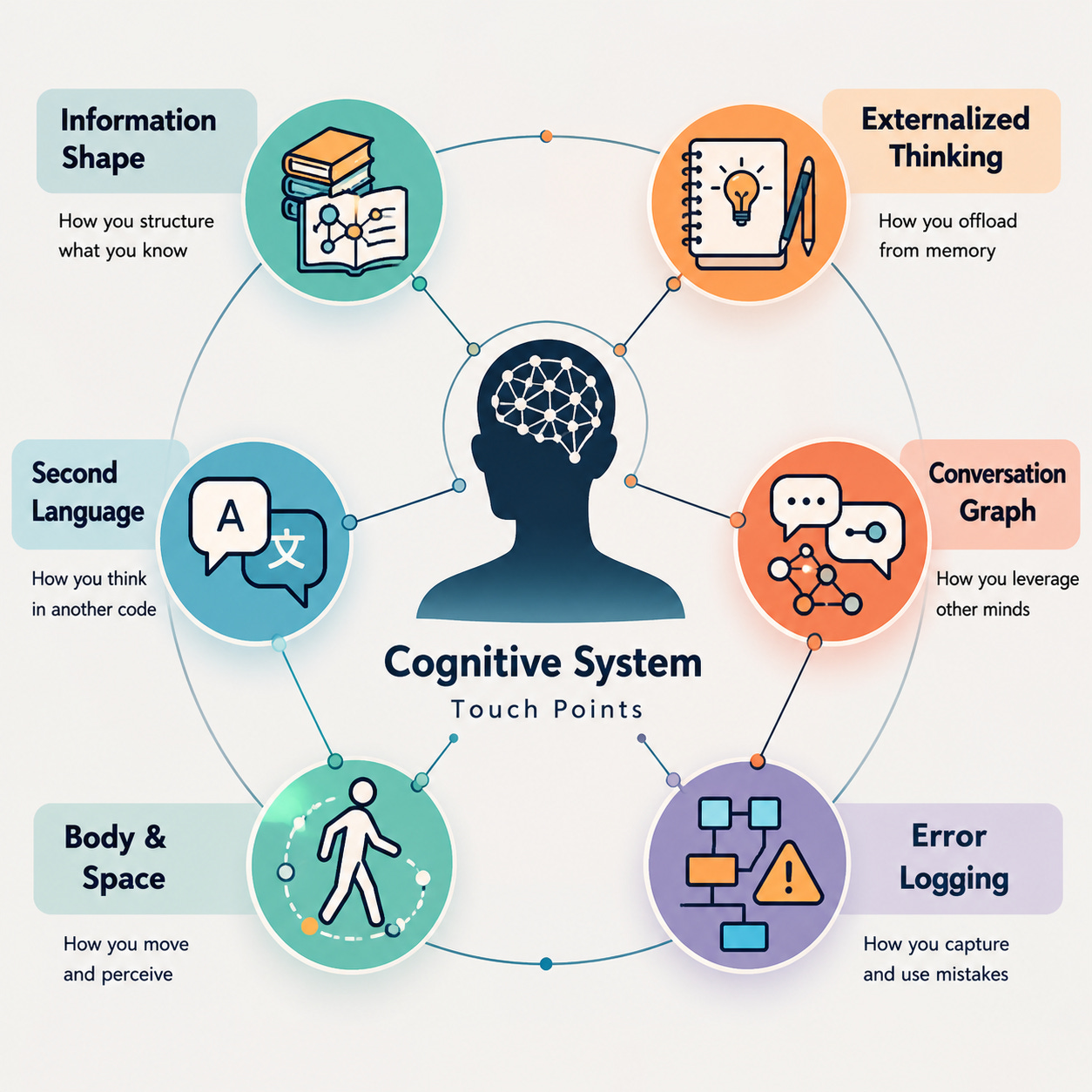
Change the shape of your information, not just the source
Most people “diversify their information diet” by swapping platforms: Twitter → Reddit, YouTube → podcasts, Instagram → TikTok.
Different apps, same structure:
short
emotionally optimized
algorithmically curated
No sustained argument required
If you keep the structure constant, you keep the cognitive habits constant.
If you want your mind to process differently, you have to give it differently shaped data:
Old textbooks and monographs: long argument chains, no SEO, no clickbait.
Internal technical reports: messy data, failed experiments, trade-offs in the open.
PhD literature reviews: brutally dense, every sentence sitting on top of dozens of papers.
These aren’t “smarter” sources in a moral sense. They simply force your brain to operate with long-term horizons, delayed payoff, and tolerance for ambiguity.
You’re not just upgrading your knowledge. You’re retraining your parser.
Externalize thinking: paper and screens as working memory
For all the productivity porn we consume, one constraint doesn’t move: working memory. Under real conditions, you can reliably juggle around four chunks of information.
Beyond that, your brain is basically doing:
remember 1–4 things
drop one
Go back to retrieve it
lose track of something else
If you try to reason about a 12-variable decision entirely in your head, you’re not “thinking deeply.” You’re thrashing.
Externalization is not about making pretty notes. It’s about extending your RAM:
Mathematicians don’t cover boards in symbols because they’re eccentric; the blackboard is literally part of the reasoning process.
Architects and designers sketch because putting lines in space creates relationships that the eye can see and the brain can then reason about.
A rule that changes real decisions:
If a problem feels “confusing,” you don’t get to decide until you’ve filled at least one page with structure: lists, diagrams, assumptions, worst-case scenarios.
If it still feels confusing after that, good — now at least the confusion is in front of you, not smeared across your head.
Keep reading with a 7-day free trial
Subscribe to Caritas Foundation to keep reading this post and get 7 days of free access to the full post archives.